
Melting and Re-Freezing in Markovian and non-Markovian Open Quantum Time Crystals
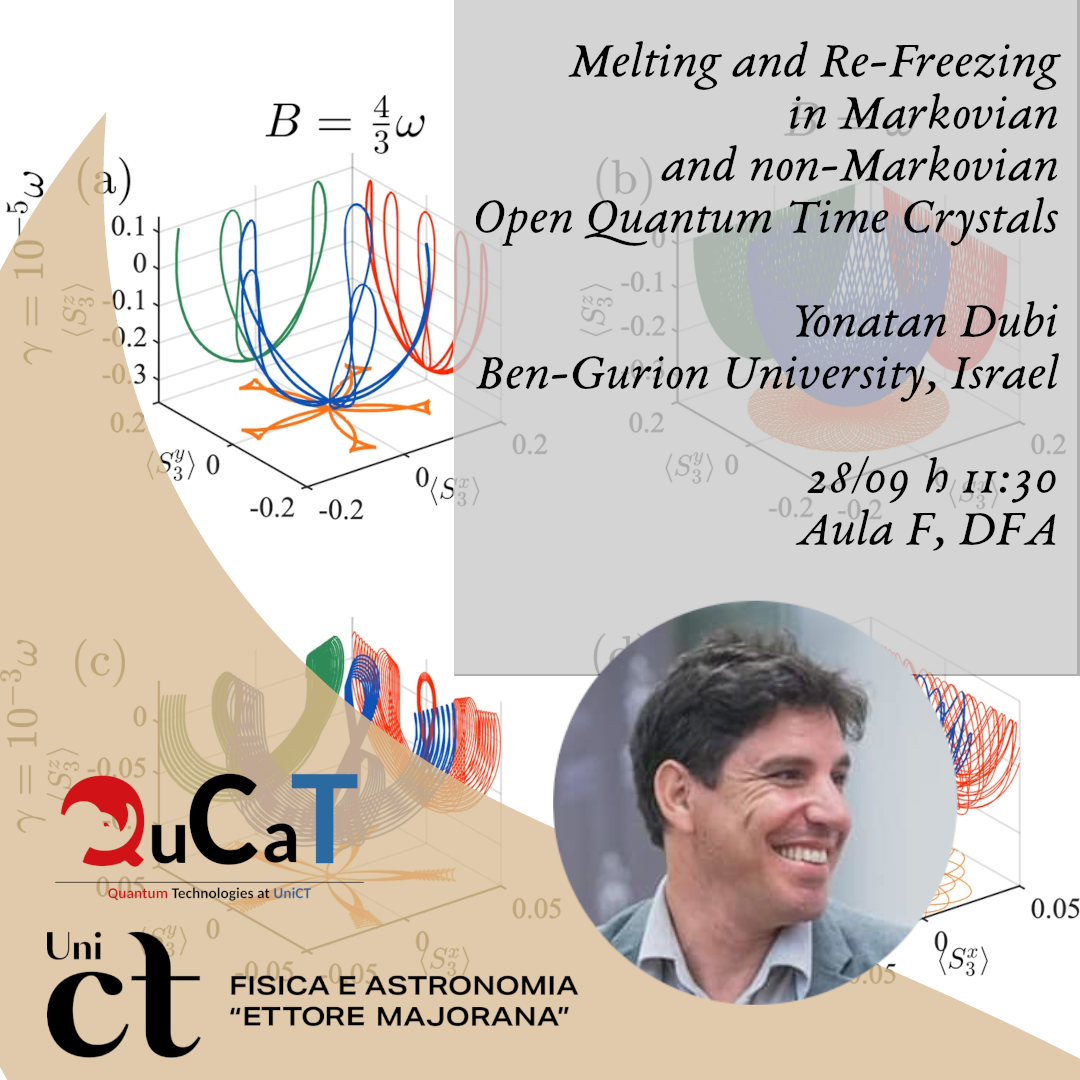
Giorno 28 settembre 2026, con inizio alle ore 11:30, presso l’Aula F del DFA, su invito della Prof.ssa Elisabetta Paladino, il Prof. Yonatan Dubi (Department of Chemistry and The Ilse-Kats Center for Nano-Science, Ben-Gurion University of the Negev, Beer-Sheva, 8410501 Israel) terrà un seminario dal titolo Melting and Re-Freezing in Markovian and non-Markovian Open Quantum Time Crystals.
Tutte le persone interessate sono invitate a partecipare.
Abstract.
Time crystals – many-body systems whose observables oscillate persistently, spontaneously breaking time-translation symmetry – have moved from curiosity to laboratory reality, but almost exclusively on atom-cavity and optical-lattice platforms, and almost exclusively under the Born–Markov assumption of a memoryless environment. This talk challenges both restrictions.
I begin with detection. Discrete time-crystalline (DTC) order is conventionally read out optically, through spin-dependent fluorescence or magnetization. We showed [1] that a periodically driven spinless Hubbard ladder, emulable in a gate-defined quantum-dot array, hosts a dissipative DTC visible directly in the charge current, as a subharmonic peak in its Fourier transform, and that the system can be tuned reversibly out of and back into the time-crystal phase. Extending this to spinful transport [2], we used dynamical symmetries to identify analytically when DTC and discrete time-quasi-crystal order survive coupling to electrodes — a general and invasive environment providing single-particle gain and loss — and showed that the spin-polarized current is itself a direct measure of time-crystallinity. Turning to molecular platforms [3], we predicted DTC behavior in arrays of exchange-coupled single-molecule magnets, where the response frequency is set by the anisotropy-defined level structure and is essentially independent of the exchange coupling, while the many-body character surfaces as a pulse-like magnetization envelope. The second half concerns bath memory. Real reservoirs have a finite correlation time. We find [4] that non-Markovianity re-freezes a dissipative time crystal that Markovian damping would melt: information backflow opens a spectral bottleneck that suppresses decay channels while leaving oscillation frequencies nearly fixed, with the damping rate vanishing as a power law in the memory time. Finally [5], we prove that the Floquet spectrum of a post-Markovian DTC splits exactly into the ordinary Markovian spectrum plus a replica of the purely unitary spectrum, uniformly contracted by exp(−T/τm). Once the memory time exceeds the Markovian lifetime, this replica sets the subharmonic decay, which then becomes independent of drive amplitude, interaction strength, dissipation rate and system size — a rigid, calibration-free read-out of the reservoir correlation time. The time crystal thereby witnesses the non-Markovianity of its own environment.
References (order of appearance = chronological)
[1] S. Sarkar and Y. Dubi, Nano Lett. 22, 4445 (2022)
[2] S. Sarkar and Y. Dubi, Commun. Phys. 5, 155 (2022)
[3] S. Sarkar and Y. Dubi, ACS Nano 18, 27988 (2024)
[4] R. Ghosh, S. Sarkar, and Y. Dubi, Freezing a molten dissipative time crystal with non-Markovianity (2026, under review)
[5] R. Ghosh, V. Mukherjee, and Y. Dubi, Experimentally relevant witness for non-Markovianity in discrete time crystals (2026, in preparation)
Dettagli aggiuntivi
Category -